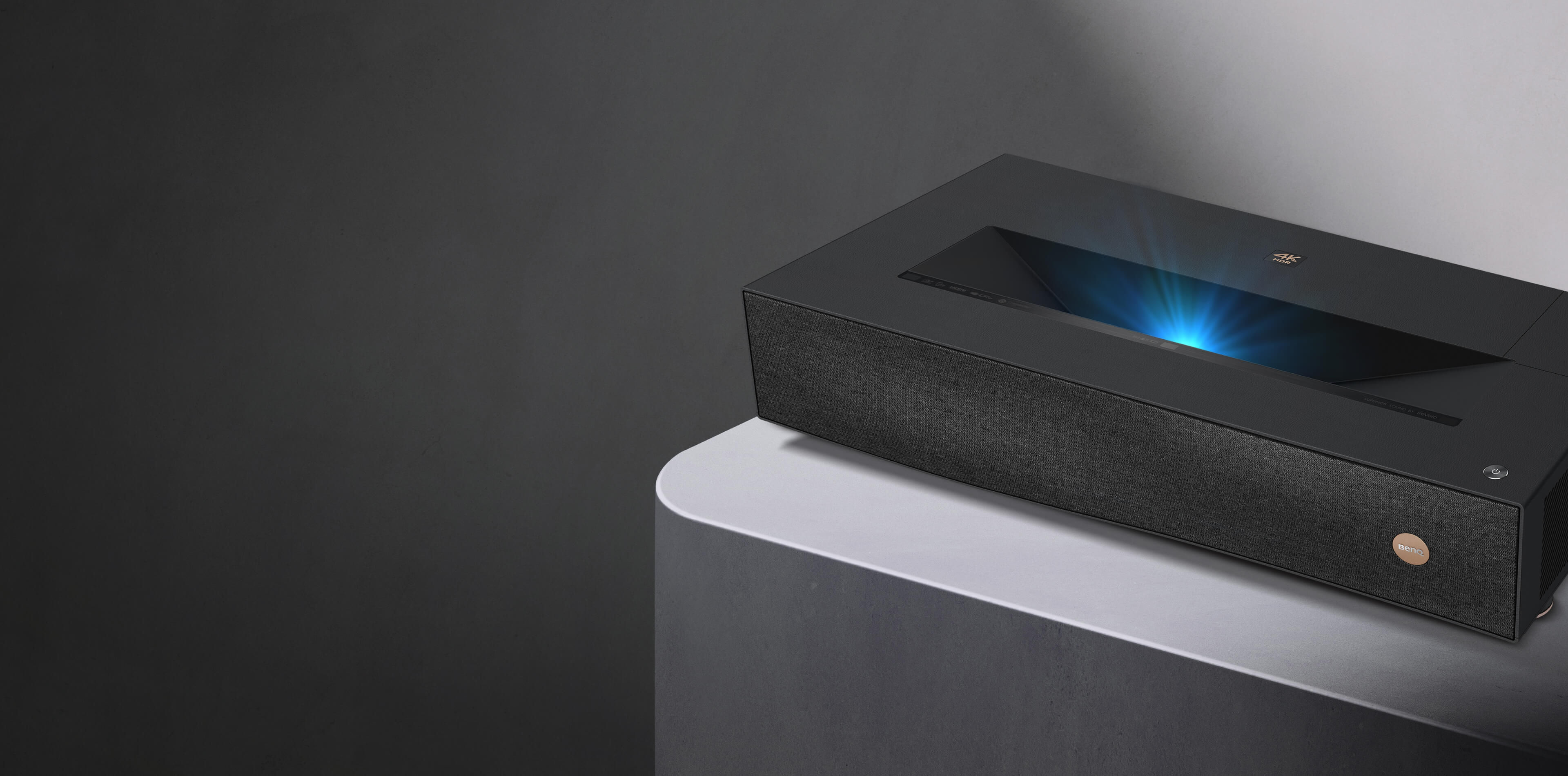
BenQ V5000i vs Epson EpiqVision Ultra LS650

BenQ V5000i is better for gaming, quieter and broader on HDR. Epson EpiqVision Ultra LS650 is $700 cheaper and lighter.

Key differences
White light output
2,500 lm ANSI3,600 lm ISO (Normal power)
Throw ratio
0.25:10.26:1
Lowest input lag
8.7 msDerived—
HDR formats
HDR10, HDR10+, HLGHDR10, HLG
Light source
RGB triple laserLaser (phosphor)
Fan noise
Normal 28 dB(A) · Eco 26 dB(A)Normal 36 dB(A) · Eco 23 dB(A)
MSRP
$3,499$2,799
Room fit
Distance to screen
0.55 m0.58 m
Picture
White light output
2,500 lm ANSI3,600 lm ISO (Normal power)
Colour light output
—3,600 lm (Normal power)
Brightness by mode
—Max 3,600 lm · Normal 2,000 lm · Eco 1,800 lm
Eco brightness
—50%Derived
Imaging technology
DLP3LCD
Chip / panel diagonal
0.47 in—
Panel alignment
—Zone-by-zone
Native resolution
1080p (1920 × 1080)1080p (1920 × 1080)
Native aspect
16:9Derived16:9Derived
Pixel shift
—4K PRO-UHD
Addressable resolution
4K UHD (3840 × 2160)4K UHD (3840 × 2160)
Dynamic contrast
2,500,000:1Over 2,500,000:1
Dynamic contrast method
Light-source dimming—
Colour gamut
Rec. 709 100% · DCI-P3 98% · BT.2020 95%—
Colour bit depth (per channel)
10 bit10 bit
HDR formats
HDR10, HDR10+, HLGHDR10, HLG
Tone mapping
—Dynamic
Tone mapping (maker name)
HDR-PRODynamic Tone Mapping
Colour management (CMS)
—None
Greyscale control points
11—
Picture certifications
Filmmaker Mode—
3D
YesNo
Light source
Light source
RGB triple laserLaser (phosphor)
Emitter
RGB triple laserBlue laser + phosphor
Light-source life
20,000 h normal · 20,000 h eco20,000 h normal · 20,000 h eco
Warm-up time
About 30 s—
Optics
Throw ratio
0.25:10.26:1
Throw measured from
—Rear of the case
Image size
70–100 in60–120 in
Projection offset
124%—
Zoom
NoneDigital
Focal length
2.4 mm3.7 mm
Aperture (f-number)
21.6
Focus
MotorisedManual
Autofocus
—No
Vertical keystone
30°—
Horizontal keystone
30°—
Auto keystone
Yes—
Corner correction
8-point8-point
Auto setup
Fit to screenFit to screen
Motion & gaming
Frame interpolation (MEMC)
YesYes
Max input refresh
1080p: 240 Hz · 4K UHD: 120 Hz1080p: 120 Hz · 4K UHD: 60 Hz
Input lag
1080p: 60 Hz 17.9 ms · 120 Hz 21.2 ms · 240 Hz 8.7 ms · 4K UHD: 60 Hz 17.9 ms—
Gaming features
ALLM—
Inputs & control
HDMI inputs
HDMI 2.0 (HDCP 2.2) · HDMI 2.0 (eARC, HDCP 2.2) · HDMI 2.1 (HDCP 2.2) · HDMI 2.0 (HDCP 2.2, internal)HDMI 2.0 (HDCP 2.3, 18 Gbps) · HDMI 2.0 (eARC, HDCP 2.3, 18 Gbps)
Max input resolution
4K UHDDCI 4K
USB media playback
YesYes
Control ports
RS-232, 12 V triggerNone
Horizontal scan
15–135 kHz—
Vertical scan
23–240 Hz—
Smart platform
Wi-Fi
Wi-Fi 5Wi-Fi 5
Bluetooth
5.05.1
Smart platform
Android TVAndroid TV
OS version
—11
Google-certified
Yes—
Security updates until
31 Dec 2026—
Netflix
Via dongleNo
Casting
Chromecast built-inChromecast built-in
Smart home
—Google Home
Audio
Speaker power
40 W20 W
Speakers
43
Layout
—2.1
Tuned by
treVoloYamaha
Audio outputs
3.5 mm, Optical, HDMI eARCOptical, HDMI eARC, Bluetooth
HDMI audio return
eARCDerivedeARCDerived
Bluetooth speaker mode
—Yes
Physical & installation
Dimensions (W × D × H)
760 × 358 × 164 mm467 × 400 × 133 mm
Weight
13,210 g7,400 g
Colours
—Black, White
Orientations
—Table
Exhaust
—Side
Dust filter
—Replaceable
Environment & power
Operating temperature
0–40°C5–35°C
Operating humidity
10–90%RH20–80%RH
Altitude
3,000 m · high-altitude mode3,048 m · high-altitude mode
Power draw
Max 180 W · Normal 150 WMax 278 W · Normal 278 W · Eco 186 W
Standby
Up to 0.5 W0.5 W
Networked standby
—2 W
Mains input
100–240 V · 50/60 Hz100–240 V · 50/60 Hz
Fan noise
Normal 28 dB(A) · Eco 26 dB(A)Normal 36 dB(A) · Eco 23 dB(A)
Safety & support
Laser class
Class 1Class 1
Risk group
RG2RG2
Eye-protection sensor
YesYes
Marks
—FCC, UL
Warranty
3 yr2 yr
User manual
—https://files.support.epson.com/docid/cpd6/cpd63492.pdf
In the box
In the box
Power cord, Remote, Remote batteries, Quick start guide, Warranty card, Streaming donglePower cord, Remote, Remote batteries, Quick start guide
Remote
Voice—